
How Two UCSF Medical Students Are Expanding Their Impact Beyond the Classroom and Clinic
UCSF medical students are encouraged to apply what they learn beyond the classroom and clinical setting – advancing patient care, strengthening communities, and addressing complex challenges in health care. Medical school also offers opportunities to develop leadership skills through service, research, and innovation, shaping the physicians students hope to become.
Third-year medical students Jordan Roiland and Daniel Rouhani have pursued that goal in different ways. Jordan, the first medical student selected to serve as UC Student Regent, has dedicated himself to public service and student leadership. As a Regent, he will bring student perspectives and voices to inform the deliberations of the university system’s governing board. Daniel has combined his medical education with innovation and entrepreneurship as the founding chief scientific officer of SYLKE, where he helps lead the development of silk fibroin dressings for surgical skin closure.
We asked both students how balancing these pursuits with medical school has shaped their perspectives and influenced the kind of physicians they hope to become.
What inspired you to pursue this work while attending medical school?
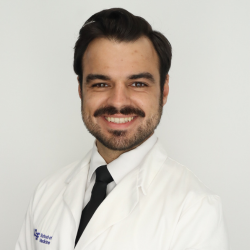
Jordan Roiland: Student leadership and public service have always been important to me. I have always believed that if something is wrong, it can’t be changed until someone speaks up. That conviction also comes with an awareness of my own privilege – the expectation that my voice will be valued, heard, and capable of creating change. As a medical student in the UC Berkeley-UCSF Joint Medical Program (JMP), I have learned to use that privilege to elevate the voices of others, particularly those who are not represented in the spaces I occupy.
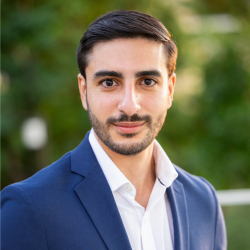
Daniel Rouhani: Before medical school, I was part of an early team studying a silk fibroin dressing for surgical incisions. I helped lead the clinical studies and scientific development as the research grew into a company. Seeing the work move beyond our trials and into clinical use made me want to remain involved during medical school. I felt a responsibility to continue supporting the evidence and patient-safety efforts behind the product.
How has your experience at UCSF shaped your understanding of leadership, advocacy, and service?
J.R.: While preparing for meetings with members of Congress, my JMP classmates and I learned the power of stories. Members of Congress are familiar with the statistics presented in policy briefs, but they do not always have access to the stories behind them. Data reveal the trend; stories reveal the nuance and concrete effects on people’s lives. I have seen how leaders are at their best when they elevate and balance different voices while paying close attention to the perspectives that are missing.
D.R.: UCSF has taught me how to be a better advocate for my patients. That begins with listening to their lived experiences, communicating with compassion, and understanding the social and structural factors affecting their care. It also means recognizing when the same problem is harming patients across an entire health system. I have come to see innovation as a natural extension of advocacy. Once we recognize a recurring gap in care, we have a responsibility to study it carefully and help improve it.
Can you share a particular experience when you recognized that this work was also making you a better future physician?
J.R.: Attending my first Regents meeting made this clear to me. Physicians spoke at the meeting about what they and their patients need to feel structurally supported in the clinical setting. I felt the weight of the massive privilege and responsibility to effect such change. UCSF taught me that the physician’s first responsibility is dedication and service to patients, and the second is to leverage our understanding to see what isn’t working and change it.
D.R.: One patient told us they had reacted to every adhesive used after previous operations and had started to fear recovery more than the surgery itself. That has stayed with me. It taught me that parts of care we might consider secondary can shape a patient’s entire experience. I try to carry that into clinical training by listening closely to what patients are worried about and what would help them feel safe.
What have you learned about balancing medical school with a significant commitment outside the classroom?
J.R.: There is certainly a learning curve. I begin by grounding myself in why I chose this path and what matters most to me, which helps me stay focused. UCSF has also been incredibly supportive. When I was offered the role, my clerkship director didn’t say, “Let’s see if this will work.” She asked, “What do you need to make this work?” Additionally, former UC Student Regent Sonya Brooks said you must be “an expert in time management” and “an exquisite planner,” and I couldn’t agree more.
D.R.: Medical school has always been my primary commitment, but I have learned that it is not separate from the work I lead outside of the classroom. There are mornings when a resident is teaching me to close a wound with the dressing I helped develop, and evenings when I am reviewing the dressing’s safety and clinical performance in other countries. Being a student is what makes me better at that work.
How do you hope to carry these experiences into your future career in medicine?
J.R.: I envision a future where structural advocacy is central to my career in medicine. Serving on the Board of Regents will help me develop the ability to examine complex problems and craft meaningful proposals that strengthen the University and address student concerns. I plan to continue training and serving in public institutions and hope to leverage the skills I develop as a physician to ensure all patients are represented in the decision-making process.
D.R.: I hope to become a practicing plastic and reconstructive surgeon. What draws me to the field is the way surgeons can take tissue from one part of the body and give it a new purpose elsewhere, restoring form and function for the patient in front of them. To me, that kind of creative problem-solving is innovation in medicine. Throughout my career, I hope to study the problems my patients face and help develop, test, and bring new solutions into patient care.
Jordan and Daniel have pursued different interests beyond the classroom, but both have found that these experiences deepen rather than compete with their medical education. Through public service, leadership, research, and innovation, they are developing skills and a sense of purpose that will shape their careers as physicians.
Jordan offers his fellow students simple advice: “Pursuing what you are interested in outside of medicine is not just crucial,” he said. “It is essential.”


