
Improvement Is Cool: From Insights to Action at UCSF’s 2025 CMC Health Systems Improvement Symposium
On Wednesday, December 3, the UCSF School of Medicine community gathered in Cole Hall on the Parnassus Heights campus to celebrate a year and a half of dedicated quality-improvement work by 30 teams – each composed of five to six second-year medical students working with their Bridges faculty coach. The Clinical Microsystems Clerkship (CMC) Health Systems Improvement Symposium marked the culmination of 18 months of hands-on systems improvement projects, showcasing the impact students have already had at UCSF Health, Zuckerberg San Francisco General Hospital, and the San Francisco VA Health Care System.
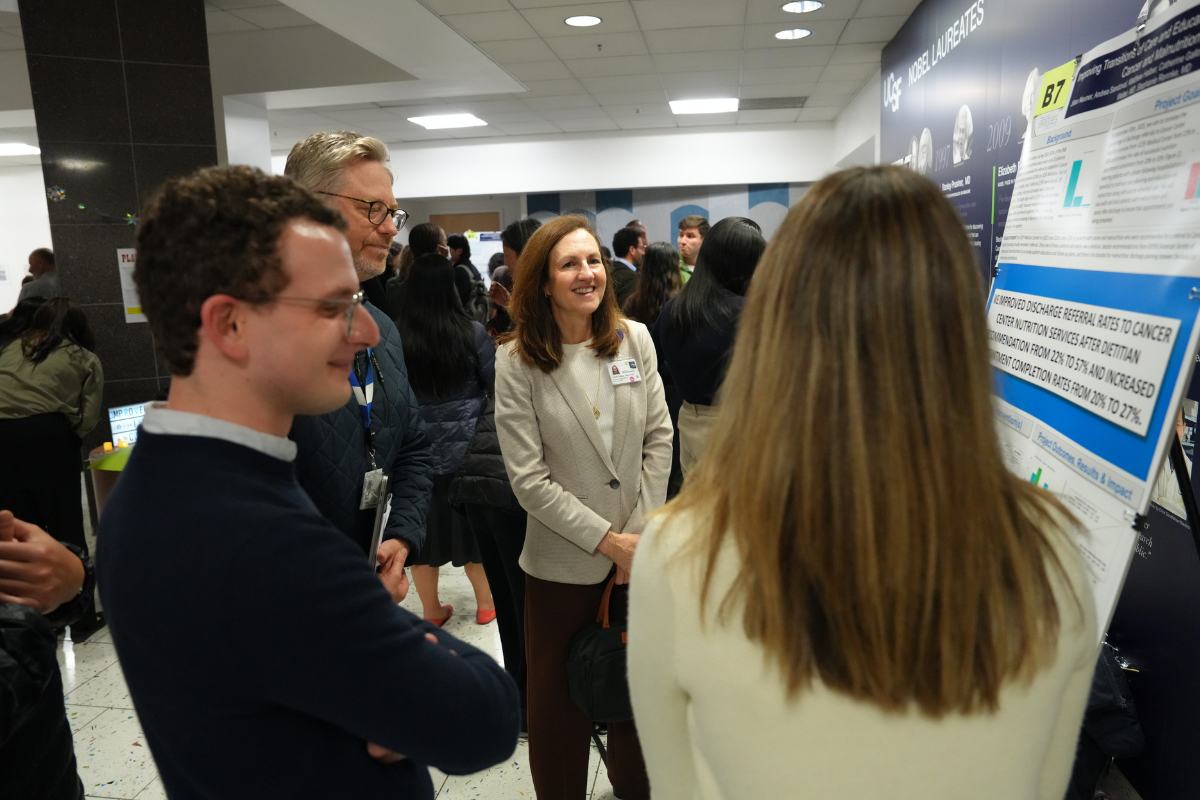
Cole Hall and its lobby were transformed into a winter-wonderland celebration, complete with snowflake décor, treats, and CMC-branded souvenirs. Thirty student groups lined the lobby with posters summarizing the problems they tackled and the outcomes they measured.
The evening opened with remarks from CMC Health Systems Improvement Co-Directors Dr. Catherine “Cat” Lau and Dr. Lei Choi, who reflected on the uniqueness of the CMC experience and the creativity students brought to their projects. “Our motto for this year is Improvement is Cool,” Dr. Lau said, “Students get to transform their learning into strategic experiments that they can implement in an actual clinical setting.”
Vice Dean for Education Dr. Karen Hauer followed with an invitation for students to carry their systems lens into their clerkships. She emphasized “the powerful impact students can have for patients, interprofessional colleagues, and our health care system,” and underscored a central lesson of quality improvement: “The importance of probing deeply to understand what the problem is we are trying to solve…and how we can take systematic approaches to designing interventions and measuring the impact of those interventions, rather than jumping to quick fixes.”
The symposium’s oral presentations highlighted four projects representing a range of challenges students pursued, from emergency medicine workflows to post-hospitalization care transitions.
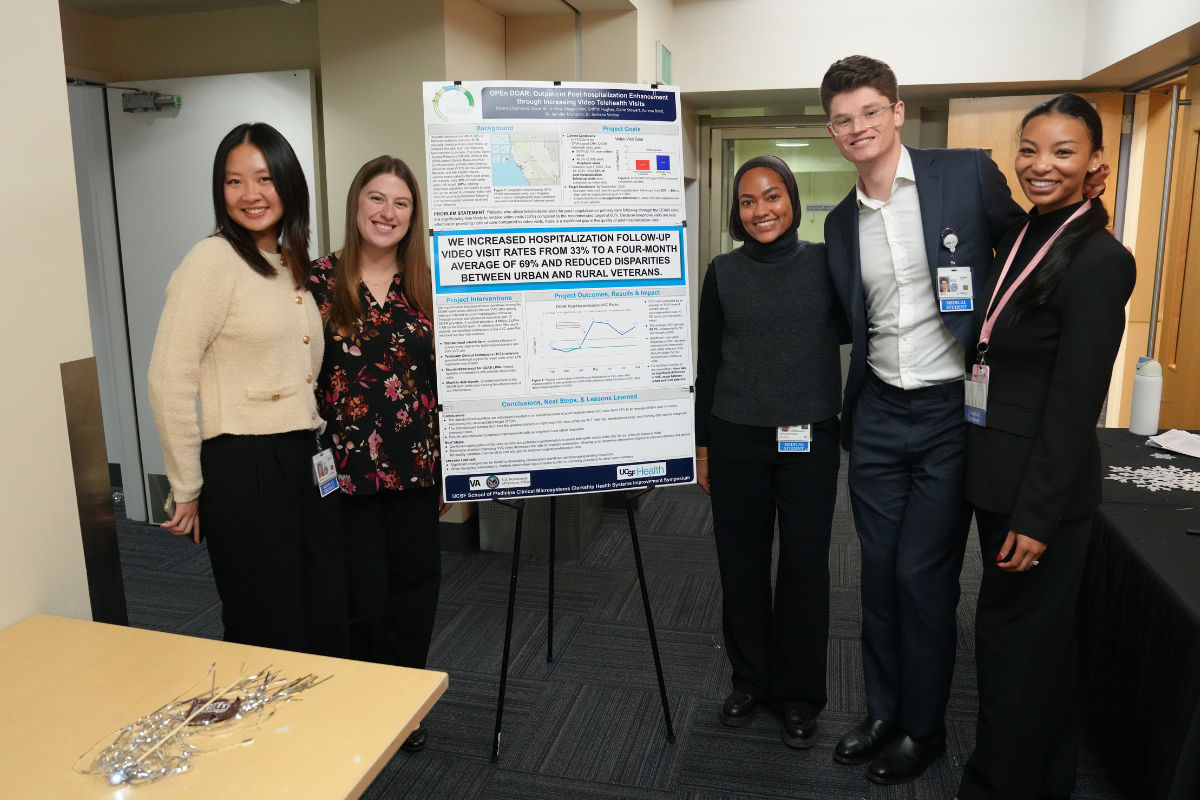
One presenting team, led by MS2 Fatima Elzamzami along with teammates Oscar De La Rosa, Maggie Han, Griffith Hughes, Claire Stewart, and Korena Boyd under the guidance of Archana Sridhar, MD, focused on improving follow-up video visit rates after hospital discharge through OPEn DOAR (Outpatient Post-Hospitalization Enhancement), at the SFVA. “Working on this project gave me a deep appreciation for the complexity of implementing change within a microsystem,” Elzamzami shared. Even ‘simple’ processes are made up of many interdependent steps carried out by staff who are already operating at full capacity.”
Their project required mapping a clinic that spans multiple states – including the Pacific Islands – and designing interventions such as standardized referral forms, targeted reminders, and scripts to help staff explain the value of video visits without adding burden. “I’m most proud of the strength of our team dynamic,” Elzamzami said, “and the fact that we successfully implemented changes that were both meaningful and sustainable.”
Her teammate, MS2 Griffith Hughes, emphasized how unique the experience was for medical students in their first years of training, “We get to embed ourselves in a health system, primary care at the VA, that we probably wouldn’t have been able to work in otherwise. It is wonderful to know the projects we are working on had a tangible, real impact.”
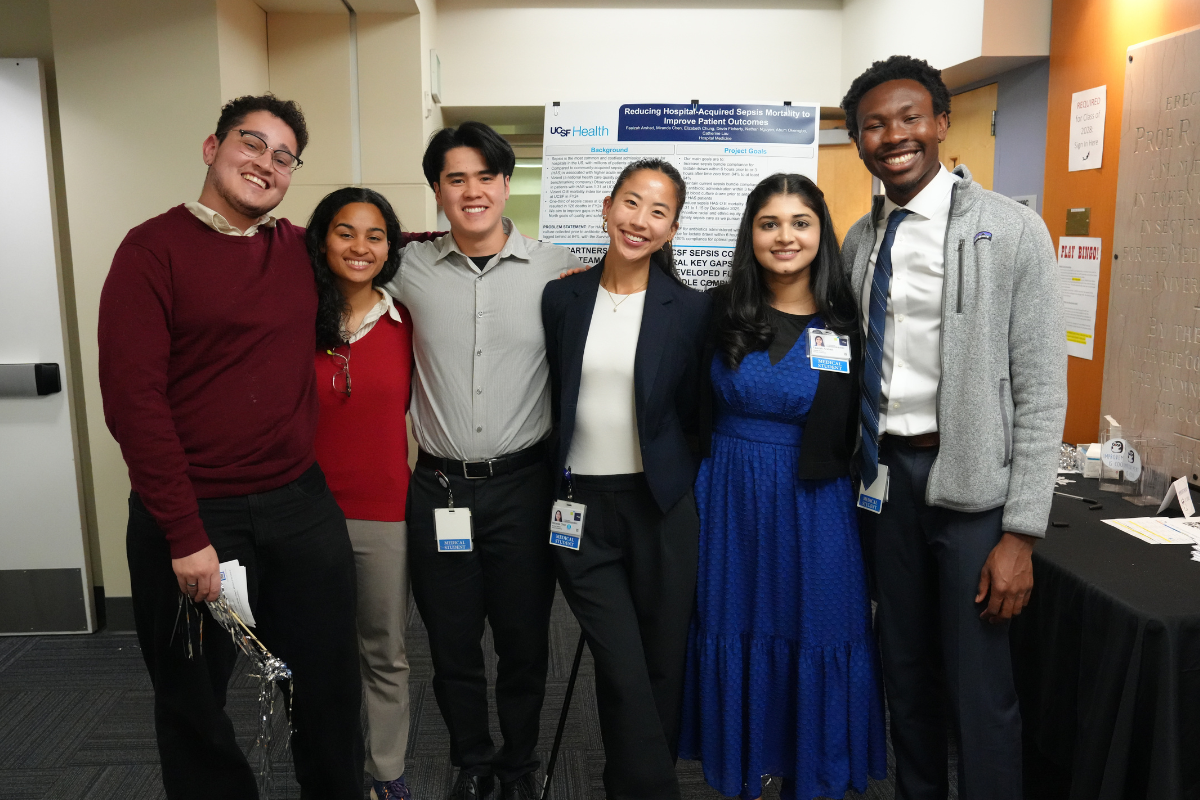
The second project, led by MS2s Faaizah Arshad, Miranda Chen, Elizabeth Chung, Devin Fleharty, Nathan Nguyen, and Abum Okemgbo with faculty coach Catherine Lau, MD, aimed to reduce hospital-acquired sepsis mortality at UCSF Parnassus. The team developed educational materials, conducted targeted talks, and trained nurses on their ability to order blood lactate measurements to screen patients with suspected sepsis. Their interventions contributed to raising lactate measurement compliance toward a 94% target and helped reduce the hospital-acquired sepsis observed-to-expected mortality index from 1.31 to 1.15.
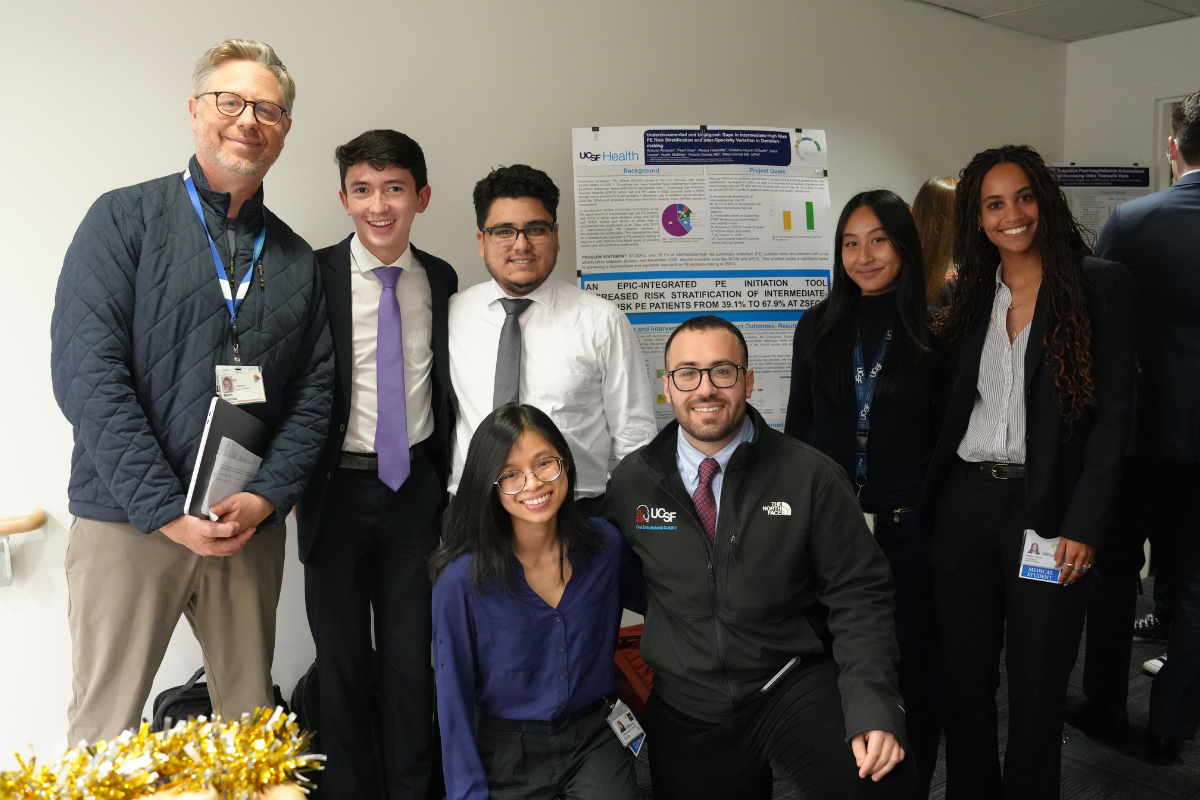
Next, MS2s Antonio Almazan, Pearl Doan, Alireza Hatamifar, Christine Huynh-O’Keefe, Keza Levine, and Austin McBride, coached by Dr. Miles Conrad at ZSFG, presented work on identifying gaps in intermediate- to high-risk pulmonary embolism (PE) risk stratification. The team implemented a new risk-stratification feature in the electronic health record and a Pulmonary Embolism Response Team (PERT) pathway—significant systems-level achievements. Their efforts increased documented risk stratification from 39% to 68%, improving consistency in decision-making and reducing variation in care.
Reflecting on the experience, McBride shared: “I realized how– even with the hoops and barriers– it’s still possible to create tangible change in our hospital systems when you have dedicated teamwork and collaboration. Medicine and our medical systems are not stagnant, and we should continually advocate for and pursue positive change whenever possible.”
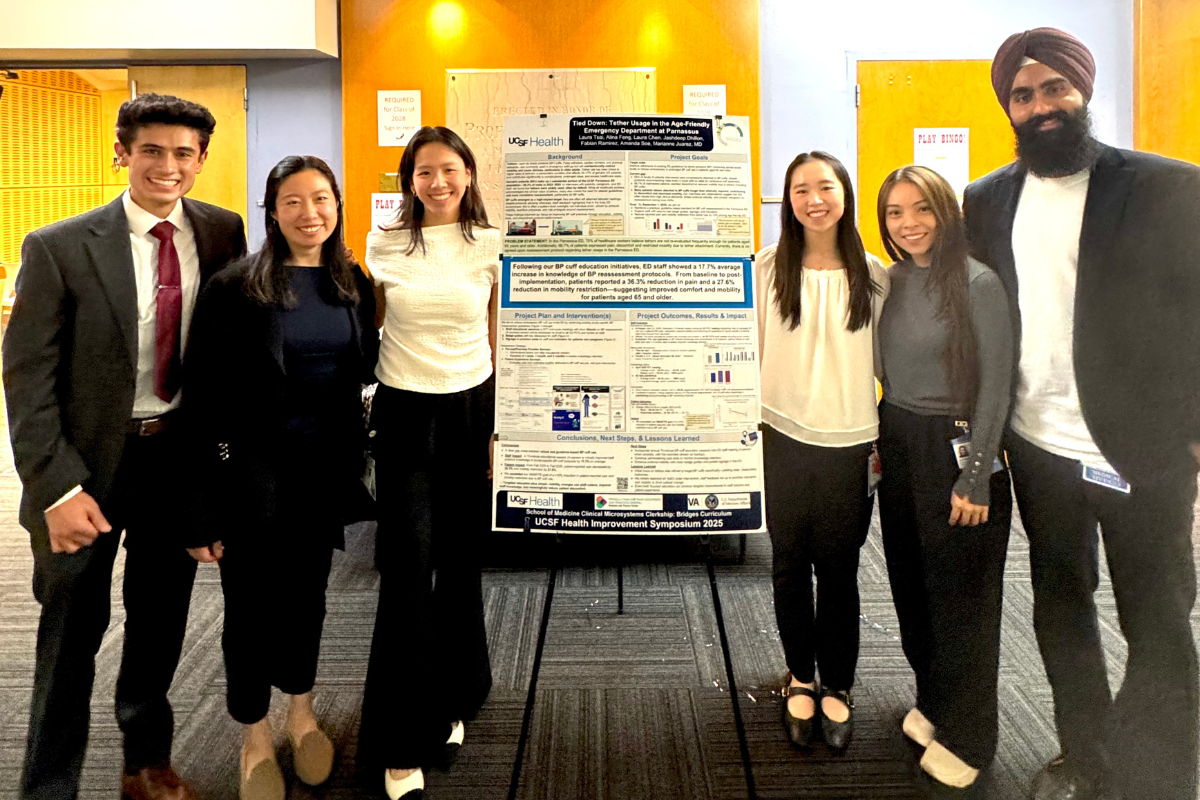
The fourth project, Tied Down: Tether Usage in the Age Friendly Emergency Department at Parnassus, led by medical students Laura Chen, Jashdeep Dhillon, Alina Feng, Fabian Ramirez, Amanda Soe, and Laura Tsai with faculty coach Marianne Juarez, MD, aimed to develop and implement a standard for reevaluating the need for tethers—particularly blood pressure cuffs, which can cause pain and limit mobility. Interventions included educational sessions and signage for both staff and patients. Their work led to a 28% decrease in patients reporting tether-related mobility restriction and a 36% reduction in pain.
Following the oral presentations were two poster sessions, where all 30 student groups presented their work. Students, faculty coaches, and deans circulated through the rows of posters, asking questions and celebrating milestones.
To close the evening, Dean Talmadge E. King, Jr. offered remarks celebrating the M2 students’ accomplishments and marking their transition into clerkships. He reminded them to bring their mindset of inquiry and systems awareness onto the wards—skills that will serve their teams and their patients well.
Reflecting on the past 18 months, Dr. Lau shared: “My hope is that students take the tools and skills they’ve learned to continue making our health care systems better and more equitable. We truly need more physicians who not only have amazing clinical knowledge and communication skills, but also outstanding systems problem-solving skills.”
Dr. Choi echoed that sentiment, focusing on the confidence students gain in the process: “I hope students carry forward a spirit of curiosity and confidence in tackling difficult problems, even ones that have been around for a long time. Their fresh perspective is a superpower.”
She noted how frequently students are surprised by their own impact: “Even early in their careers, students can see their work ripple across patients and teams.”
As the Class of 2028 moves into clinical rotations, the symposium highlighted that students can make real improvements in health care systems even early in their training. It also showed that improvement really is cool, and these students are already proving it.


