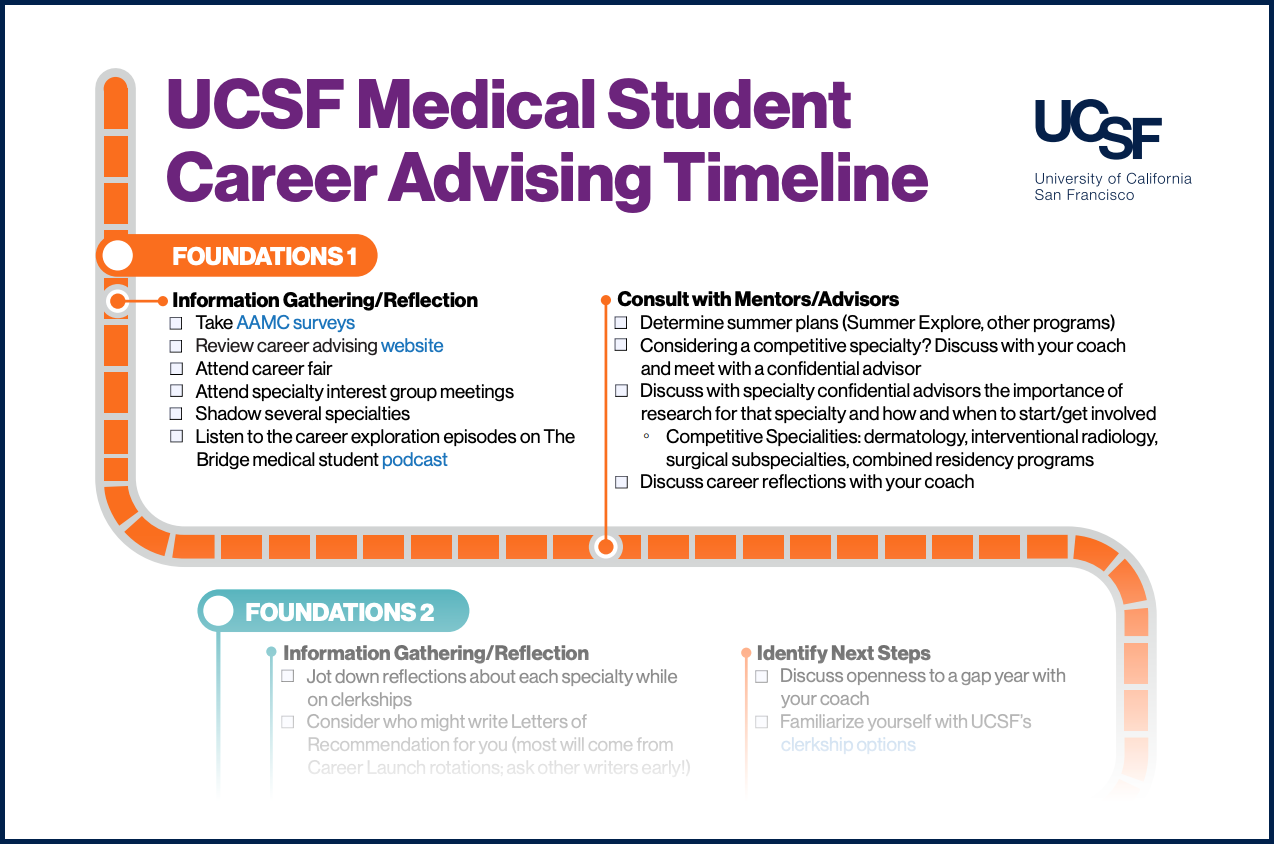
The Career Advising system is integrated within the Bridges Curriculum and aligns with the Physician Identity weeks, giving students time to review resources and discuss questions with their medical student coach. The Career Advising Timeline helps students: visualize where they are in their medical student career journey, track their progress toward graduation and residency, and identify actionable next steps to achieve their career goals.
Watch Career Advising Program and Video Lectures on choosing a specialty, using clerkships for career exploration, and more. Below is an overview of the career advising program. You can see how career advising is incorporated into Physician Identity Weeks throughout your time at UCSF. Watch specialty information video sessions and overview lectures on choosing a specialty, using clerkships for career exploration, and more.
Foundations 1
Medical School Orientation (August)
Introduction to the Career Advising Program and Student Experience Team
WATCH: A Post-Match Panel: Students who have matched into surgical and medical specialties discuss the process of choosing specialties, compiling applications, interviewing for residencies, and creating a rank list
The Checklist tells you what you need to do during each year of medical school at UCSF to stay on track and support you along this journey. Follow these steps to take at different phases of medical school to prepare for your career in medicine.
Foundations 1
Physician Identity Weeks 1 – 3
Consider attending the Student Organization Fair in August
Set a goal to do one exploratory activity – attend at least one student interest group and/or sign up for a shift in a student-run clinic
Perform at least one informational interview
If you are interested in a competitive specialty (surgical subspecialties, dermatology, emergency medicine) meet with the confidential specialty residency advisor within the first year of medical school
Near the end of F1, you will choose Clinical Immersion Experiences (CIExs) that can be used to explore career interests outside of the F2 core clerkships
Work to establish mentorship in at least one potential specialty field.
Identify potential mentors/advisors (faculty, fellows, residents, senior med students, etc.) about your interest and follow-through after the clerkship for career advice, potential sources for letters of recommendation
If you are interested in taking a gap year, meet with your Coach and/or mentors to discuss interest in and plan for gap year
If you are interested in pursuing external degrees during your gap year, plan ahead early -- in case you need to take qualifying exams, obtain letters/transcripts and submit your application
If you have selected a career path, clarify with the confidential specialty residency advisor whether or not you are competitive in this field and how to strengthen your application
Identify an Inquiry mentor
Consider which Career Launch experiences will best prepare you for your career path
Career Launch
Again clarify your career/specialty goals and reflect on whether or not you are competitive for the specialty you wish to pursue.
Consider how your Inquiry/Deep Dive project can align with career exploration and/or goals and identify a project and mentor for Inquiry
Consider which Career Launch experiences can enhance career exploration and/or strengthen your skills/knowledge/CV, define the appropriate timing for your residency application
Residency Application: Key Dates, Deadlines and Checklist by Month
May
Submit your MSPE information by the assigned deadline
Begin to solicit letters of recommendation if not already done. Many letter writers will not begin to write their letters until you provide a draft of your personal statement, but it is important to ask them to commit to writing a strong letter for you
Check with individual residency programs on their policies for completing Step 2
Activate access to the Texas STAR database
Applicants to military residency programs should contact the branch of the military to which they are applying
June
Electronic Residency Application Service (ERAS) opens. UME issues tokens for registration to all students who plan to graduate the following spring
Attend ERAS orientation session
Work closely with your specialty advisor to develop an initial list of programs
Urology applicants register with the American Urological Association residency match
Applicants to preliminary or transitional programs should meet with the Medicine-Prelim advisor
July/August
Draft your personal statement and review it with your specialty advisor or Coach
Ophthalmology applicants register with SF Match. Ophthalmology programs have individualized target dates for application submission, which may be different — and earlier — than the September 15th target date specified in SFMatch. Check with each program on their recommended date to submit your application
Military residency match program (MODS) opens
MODS application due
September
Students can begin to submit completed applications to programs through ERAS. Programs will not be able to receive these applications until October 21. There is no advantage to submitting an application on September 1 vs October 20; however, we encourage you not to wait until the last minute to submit your application in case there are technical issues submitting applications at later dates.
NRMP opens for registration
October
Begin to schedule program interviews, typically for November, December, January, and February