
TSP Learner Objectives and Optional Reading
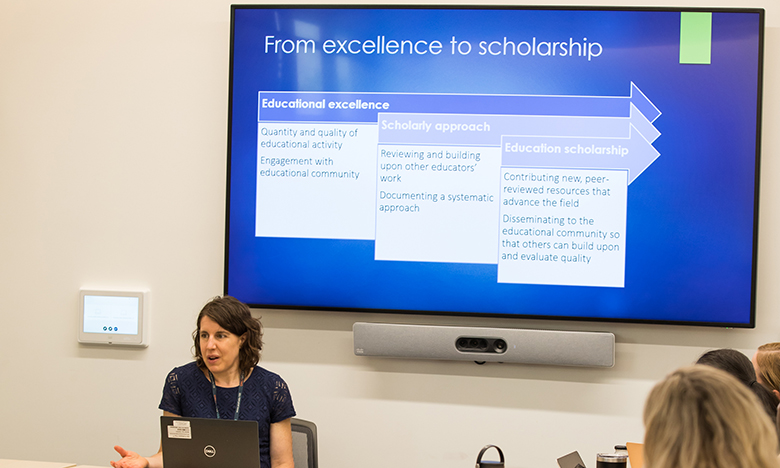
In formulating the objectives for the Teaching Scholars Program, we have made a commitment to integrate an anti-racist/anti-oppressive framing across objectives of the program. This way the program always has that perspective when examining education principles and practices. We believe in this approach rather than treating racism and oppression as separate topics since they influence all that we do as educators. Sessions focus on learning theory, curriculum development, education scholarship, education leadership and career development and they will have readings and discussions that assure that participants reflect on how anti-racism/anti-oppression are incorporated into their practices.
The topics and objectives are:
Learning theory is foundational to providing a quality education. We will discuss a range of learning theories, including behavioral, cognitive, sociocultural, and critical.
TSP participants will:
- Describe various learning theories and consider the historical and social context of these theories
- Analyze how these learning theories relate to design of curriculum and educational activities
- Evaluate the research evidence related to different learning theories and their impact on education
Curriculum is the structure through which we deliver educational content to learners. An anti-racist and anti-oppressive lens influences the approach to curriculum development by centering on learners and their capacity to thrive. Educators must create a respectful and welcoming learning environment and select pedagogical approaches that allow all learners to participate and thrive. We will draw from Universal Design for Learning and critical pedagogy.
TSP participants will:
- Analyze the processes involved in curriculum development including how to decide what to include, how to select learning strategies, how to assess learners employing an anti-deficit framing, and how to evaluate curricula in a way that includes various stakeholders
- Identify different curricular models used in health professions education
- Employ various teaching methods appropriately matched to the learners and to the knowledge, attitudes and skills to be taught, drawing from the Universal design for Learning and Critical Pedagogy frameworks
- Analyze the relationship between learning theory and teaching
- Create an inclusive learning environment
- Examine teaching strategies to determine if they are built on best practices, inclusive, and aligned with trauma informed education
- Analyze the successful use of technology to enhance learning
- Develop expertise in giving feedback that is sensitive to each individual
- Analyze the relationship between accreditation and curriculum
- Demonstrate ability to interpret reliability and validity of measures
- Examine assessments and their implementation for bias
- Analyze the strengths and weaknesses of various assessment strategies
- Design a program evaluation
Education leadership Education leadership is evolving to ensure leading in an anti-racist and anti-oppressive way that ensures the ability to lead across differences and implement change to address the needs of today’s learners.
TSP participants will:
- Examine different lenses for leadership
- Analyze the roles and expectations for educational leadership
- Develop awareness of one’s own leadership skills and how they affect leading others
- Devise a strategy for leading change
- Analyze the role of mentors in career development
- Plan one's own career development
- Explore educational leadership opportunities within and outside the university
Education scholarship advances our understanding of educational processes, learners’ and educators’ experiences, and outcomes of educational programs and interventions. In TSP we will cover a range of approaches to education scholarship, including critical and participatory approaches.
TSP participants will:
- Apply frameworks, methods, and skills covered in TSP to the design and implementation of a scholarly education project
- Explain the importance of positionality when examining researcher bias and the need for reflexivity when conducting educational scholarship
- Discuss the strengths and limitations of various research approaches
- Select conceptual frameworks, study designs/approaches, and methods that align with research questions
- Devise an analytical plan for an educational study
- Develop skills in educational research sufficient to propose, critically appraise, and discuss education research studies
- Provide reinforcing and constructive feedback on education abstracts
Optional TSP Summer Reading
Past teaching scholars have found it helpful to have a list of some of the key books and articles that are part of the TSP curriculum so they could start reading over the summer. Summer reading is NOT a requirement, but you may find it helpful to start now since the reading tends to be fairly heavy in the fall. Also, we generally only assign a portion of the books and many scholars have expressed interest in reading the whole book. Although many of these materials name “medical education” formally in the title, all of them can be applied to health professions education broadly.
- How Learning Works: Eight Research-Based Principles for Smart Teaching, 2nd ed (2023). Lovett MC, Bridges MW, DiPietro M, Ambrose SA, Norman MK.
- Assigned reading: Introduction, Chapter 1, + assigned chapter will be discussed in the Learning Theory sessions in September and October.
- This is a great book describing 8 core principles for effective teaching and learning. The examples are mostly from higher education, but the principles are easy to apply to health professions education and clinical teaching. You will be assigned one chapter to present to the group.
- Conceptual frameworks to illuminate and magnify. Bordage, G. (2009). Medical Education, 43(4), 312-319.
- This article will be discussed in the Learning Theory sessions in September and October.
- A classic article describing different types of frameworks used in medical education.
- Curriculum Development For Medical Education: A Six-Step Approach, 4th ed (2022) Thomas PA, Kern DE, Hughes MT, Tackett SA, Chen BY. Link through UCSF Library.
- Assigned reading: Chapters 1-8 will be discussed in the Curriculum Development sessions starting in October.
- This book, often informally referred to as “the Kern book” (in reference to the 2nd author) is widely used for curriculum development in health professions education.
- Understanding Medical Education, 3rd ed (2018). Swanwick T, Forrest K, O’Brien BC. Link through publisher.
- Assigned reading: Chapters 4-6. Chapter 4 will be discussed in the Learning Theory sessions in September and October; and Chapter 5 & 6 the Curriculum Development sessions in October.
- This book provides a foundation in health professions education, from theory to practice to research and scholarship. In addition to the above sessions, we will discuss chapters from this book throughout TSP.
- Foundations of the Bridges Curriculum.
- This page contains a number of modules designed to onboard new Foundations 1 leaders. The first video (11’) by John Davis describes the goal and structure of UCSF’s School of Medicine Bridges curriculum, which we will refer to throughout TSP.
