
Feedback Tips
Actionable Feedback to Help Learners Grow
Purpose: This tip sheet gives you tips for actionable feedback in everyday practice.
Background: You may think of feedback as a formal sit-down session with learners at the end of a clinical assignment to discuss their general performance. But feedback in the moment, with actionable tips that help learners grow is often much more valuable, and doesn’t have to take much time at all!
- Collect Evidence: Feedback should be about specific behaviors and not general impressions or character traits. Make sure to collect “evidence” or tangible information about a learners’ performance by observing a learner, listening to a learner’s presentation, or reading a learner’s note. It is also helpful to ask about a learner’s thought process. Collecting evidence helps you understand the learner’s experience so you don’t jump to conclusions. Also always check your biases as they can easily influence your feedback.
- Use Keep-Stop-Start: Based on the information collected, you can use the “keep-stop-start” framework to guide and discuss your feedback.
- Keep: Recognize what the learner did well and what you encourage them to keep doing. Use phrases like, “I liked how you...,” “It worked well when you…”
- Stop: If you noticed errors or unhelpful behaviors, use a stop comment. Use phrases like, “What didn’t work so well,” or “What I wouldn’t do next time…” If there is nothing to Stop, focus on Keep and Start
- Start: A start comment provides actionable tips for further growth. Use phrases like “As a next step, focus on…” or “to become more independent, try...” Always follow a Stop with a Start
- Consider Ask-Tell-Ask: Depending on the situation, it can be helpful to ask what the learner thought before delving into the “Tell” of Keep-Stop-Start. It is often also good to ask whether this is a good time to discuss feedback. End with a question to ensure the feedback made sense and helps the learner grow.
- Label you discussions as feedback! This can be part of the Ask at the beginning or end: “do you have a moment for some feedback?” or “was that helpful feedback?”.
- Document: Use an evaluation tool to document your feedback with the Keep-Stop-Start framework. Evaluation tools vary by program so please check with your clerkship or program director.
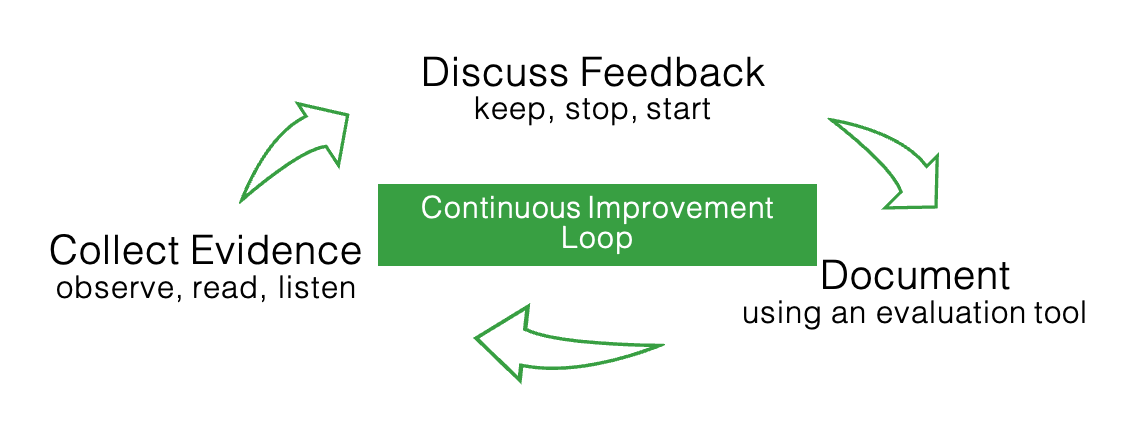
- The different aspects of feedback, collect evidence, discuss and document can become part of a continuous improvement loop. Ideally, learners have opportunities to try out what they just learned and get feedback again. This is why it is best to discuss feedback early, preferentially in the moment and in small chunks rather than one big feedback session at the end of an assignment.
Content created by Sandrijn van Schaik for the UCSF CFE 2024 Licensed under CC BY-NC-SA 4.0: https://creativecommons.org/licenses/by-nc-sa/4.0/

